Barnstaple, North Devon: the complete local guide
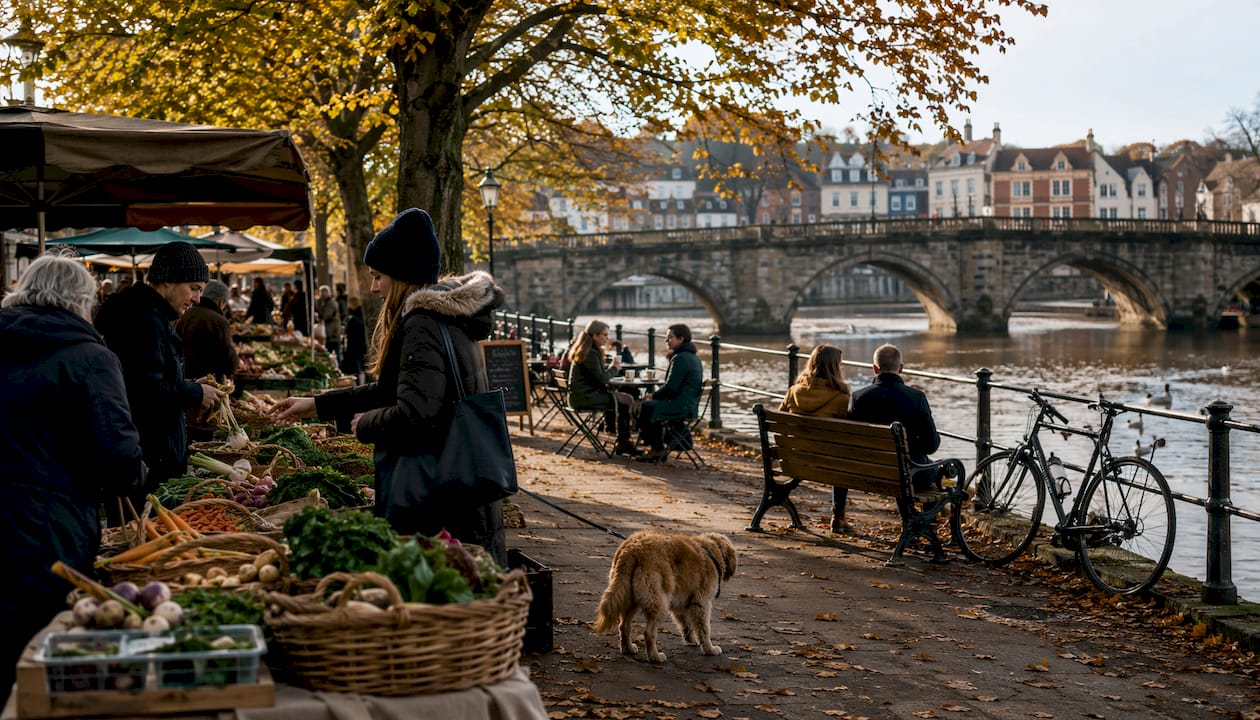
Barnstaple is North Devon’s historic market town and the practical gateway to some of England’s finest coastline and Exmoor’s open moorland. Whether you’re planning a day trip, a longer stay, or a permanent move, three things define the town immediately: the Pannier Market, the Tarka Trail along the River Taw, and a transport network that puts beaches within twenty minutes and Exeter within ninety.
Table of Contents
- What are the key facts about Barnstaple at a glance?
- How do you get to Barnstaple and around North Devon?
- What shaped Barnstaple’s history and identity?
- What are the must-see attractions in Barnstaple?
- What can you do in and around Barnstaple?
- What events and cultural life does Barnstaple offer?
- What is everyday life like in Barnstaple?
- How do you use Barnstaple as a base for day trips?
- Where should you stay and when should you visit?
- What do local sources say about living in Barnstaple?
- What conservation and environmental work is happening in the area?
- Key takeaways
- Why Barnstaple deserves more credit than it gets
- Useful sources and where to check current information
What are the key facts about Barnstaple at a glance?
| Fact | Detail |
|---|---|
| Population | Approx. 31,271 |
| Average house price | £306,501 (flats avg. £156,628) |
| Average broadband speed | 444 Mbps |
| Nearest rail station | Barnstaple (Tarka Line terminus) |
| Drive to Saunton Sands | Approx. 15–20 minutes |
| Drive to Woolacombe | Approx. 20–25 minutes |
Barnstaple suits families looking for good schools and open space, commuters who want a proper town without city prices, and day visitors who want a market, a riverside walk, and a beach all in one trip.
Pro Tip: Friday is the best day to visit the Pannier Market. That’s when food producers are most strongly represented, and the hall is at its liveliest for tasting local cheese, bread, and charcuterie.
How do you get to Barnstaple and around North Devon?
Getting to Barnstaple is straightforward from most directions, and once you’re there, the town centre is compact enough to cover on foot.
By road and rail:
- A361 from the M5 at junction 27 (Tiverton): the most direct route from the east, though it can slow significantly in summer, particularly around South Molton.
- Tarka Line from Exeter St Davids: a 75-minute scenic journey with roughly hourly services. Trains run through the Taw Valley and are genuinely one of the more pleasant rail rides in the South West.
- Bus routes: Stagecoach and First Devon & Cornwall operate services connecting Barnstaple to Bideford, Ilfracombe, and Braunton. The X9 links to Exeter on a longer schedule.
Parking and local movement:
The railway station sits just north of the town centre, a five-minute walk from the Pannier Market. Several car parks operate near the Cattle Market and along the riverfront. Bike hire is available close to the station, which makes the Tarka Trail immediately accessible without a car.
Pro Tip: If you’re coming from Exeter for a day out, take the Tarka Line and hire a bike at the station. You avoid the A361 entirely, and the cycle to Instow and back is one of the best half-days in North Devon.
What shaped Barnstaple’s history and identity?
Barnstaple is one of England’s oldest boroughs, with Saxon origins that predate the Norman Conquest. The name likely derives from the Old English Beardastapol, meaning “Bearda’s post” or pillar, though the exact etymology is debated. By the medieval period, the town had become a significant trading port on the Taw estuary, and its market tradition has continued without meaningful interruption for over a thousand years.
Three landmarks carry that history visibly. The Long Bridge, spanning the River Taw, is one of the largest medieval bridges in Britain and holds Grade I listed status. Walk across it on a clear morning and you get the best view of the town’s roofline. St Anne’s Chapel, tucked behind the High Street, is a medieval chantry chapel that later served as a grammar school, reportedly attended by John Gay, author of The Beggar’s Opera. The castle earthworks on Castle Street are all that remain of a Norman motte-and-bailey fortification, but they’re worth a short detour for the context they give the town’s layout.
For deeper historical research, the Museum of Barnstaple and North Devon holds the primary local archive and is the best starting point.
What are the must-see attractions in Barnstaple?
Barnstaple Pannier Market
The Pannier Market is the heart of the town, and not in a metaphorical way. The 1855 hall runs Monday to Saturday, with different trading themes across the week: antiques and collectables on some days, crafts and local produce on others, and Friday bringing the strongest food-producer presence. Admission is free. The building itself is worth seeing regardless of what’s on, with its cast-iron roof structure and original Victorian proportions largely intact.

Museum of Barnstaple and North Devon
Located on The Square, the museum covers North Devon’s natural history, maritime past, and local archaeology across well-organised galleries. Admission is free, and it’s a genuinely good wet-weather option for families. The ceramics collection, which focuses on North Devon’s distinctive slipware tradition, is particularly strong.
Long Bridge, St Anne’s Chapel and the castle earthworks
These three form a natural walking circuit from the station. Cross the Long Bridge for the river view, double back along the quay to St Anne’s Chapel, then head up Castle Street to the earthworks. The whole loop takes under an hour and covers the town’s medieval core without needing a guide or a ticket.

What can you do in and around Barnstaple?
For walkers:
- The Tarka Trail follows the River Taw south from Barnstaple and north towards Braunton Burrows, offering flat, well-surfaced paths suitable for all abilities.
- The riverside route from the Long Bridge to Rock Park is a short, pleasant walk with good views back to the town.
For cyclists:
- The Tarka Trail is fully traffic-free between Barnstaple and Instow (roughly 5 miles), making it one of the most accessible cycling routes in Devon. Bike hire near the station removes the need to bring your own.
- The route to Braunton and Saunton Sands is popular with road cyclists and e-bike riders.
For families:
- The Museum of Barnstaple and North Devon is free and well-suited to children.
- Rock Park, beside the river, has open green space and play areas.
- Saunton Sands (15–20 minutes by car) is one of Devon’s finest family beaches, with a long flat stretch ideal for young children and beginner surfers.
- For wider Devon family activities, the county has plenty of options within easy reach.
For food lovers:
- The Pannier Market’s Friday food stalls are the highlight, but independent cafés and bakeries around the High Street and Boutport Street are worth exploring on any day.
- The Butchers Row arcade, adjacent to the market, has a handful of independent traders worth supporting.
Pro Tip: Combine a Friday market visit with a walk along the Tarka Trail to Instow for lunch. The return journey by bike takes around 90 minutes at an easy pace, and the estuary views are excellent.
Saunton Sands is 15–20 minutes by car. Woolacombe is also reachable by car within a short drive from the town. Instow is a short cycle or a ten-minute drive.
What events and cultural life does Barnstaple offer?
Barnstaple’s cultural calendar is anchored by the market itself, which functions as a community gathering point rather than just a retail venue. Beyond that, the town has a genuine arts infrastructure for its size.
- Pannier Market trading days run Monday to Saturday, with specialist themes rotating through the week. North Devon Council publishes the current schedule on its website.
- Queen’s Theatre on Boutport Street programmes drama, comedy, and music year-round. It’s a proper regional theatre with a mix of touring productions and local performances.
- North Devon Festival and various seasonal events bring outdoor performances and community markets to the town centre in summer.
- Galleries and studios: several independent galleries operate in and around the town centre. For a broader picture of Devon’s arts scene, the county has a rich network of exhibition spaces.
For current event dates, check the North Devon Council website and the Queen’s Theatre box office directly, as schedules change seasonally.
What is everyday life like in Barnstaple?
Barnstaple functions as a genuine service hub for North Devon, which means residents have access to facilities that smaller Devon towns simply don’t offer.
Essential services and amenities:
- Schools: there are 11 schools in the Barnstaple area, with 85.7% of inspected schools rated in the top two Ofsted bands, which is a strong result for a town of this size.
- Healthcare: North Devon District Hospital is located on the edge of town, with multiple GP surgeries and dental practices in the centre.
- Supermarkets: Tesco, Lidl, Aldi, and Sainsbury’s all have stores in or near Barnstaple, alongside a Marks & Spencer food hall.
- Leisure: the North Devon Leisure Centre offers a pool, gym, and sports courts.
Housing market:
Average house prices and flats reflect the local market values. Popular neighbourhoods include Pilton (close to the town centre with older housing stock), Roundswell (a newer development with good road access), and Sticklepath. The town balances high street retailers, schools and medical facilities with proximity to the Tarka Trail and Saunton Sands, which is why it consistently attracts families relocating from larger cities.
Broadband speeds in Barnstaple are significantly higher than the national average, supporting remote working effectively.
How do you use Barnstaple as a base for day trips?
Barnstaple’s position makes it one of the most practical bases in North Devon. Here are three ready-to-use itineraries.
Half-day (3–4 hours): Start at the Pannier Market (aim for Friday morning), walk the Long Bridge and riverside path to Rock Park, then lunch at one of the independent cafés on Boutport Street. Done by early afternoon.
Full day: Cycle the Tarka Trail to Instow for a pub lunch on the estuary, then return to Barnstaple for the late afternoon. Alternatively, drive to Saunton Sands for a beach afternoon and return via Braunton for dinner. Either option works without rushing.
2–3 days: Add Woolacombe on day two (20–25 minutes by car, one of the best surf beaches in England), then Exmoor on day three. The Exmoor National Park boundary is under 30 minutes from Barnstaple, and Lynton and Lynmouth are around 45 minutes via the A39.
| Destination | Distance from Barnstaple | Typical drive time |
|---|---|---|
| Saunton Sands | Approx. 9 miles | 15–20 minutes |
| Woolacombe | — | 20–25 minutes |
| Instow | Approx. 5 miles | — |
Where should you stay and when should you visit?
Accommodation types and budget ranges:
- Town-centre B&Bs and guesthouses: the most affordable option, typically £70–£110 per night, and within walking distance of the market and river. Hotels in Barnstaple town centre are limited in number but well-placed for exploring on foot.
- Hotels in Barnstaple, North Devon: a handful of mid-range hotels operate in and around the town, generally priced £100–£160 per night. Several hotels in Barnstaple Devon offer good access to the Tarka Trail and the town centre.
- Holiday parks and self-catering: the surrounding area has numerous holiday parks, particularly towards Braunton and Croyde, which suit families and longer stays.
- Farmhouses and rural B&Bs: scattered across the surrounding parishes, these offer a quieter base with easy driving access to town.
For broader Devon holiday planning, the county has options at every price point.
Best times to visit:
- Summer (July–August): peak season for beaches and outdoor activities, but the A361 can be slow and accommodation books up quickly.
- May–June and September: the best balance of good weather, open attractions, and manageable crowds. Market days are fully operational and the Tarka Trail is at its most pleasant.
- Winter: quieter, but the market still runs and the town’s independent shops and cafés remain open. Good for walking and short breaks without the summer premium.
Accessibility and parking: The railway station has step-free access. The town centre is largely flat near the river, though some streets rise steeply towards the castle earthworks. Public toilets are available near the Pannier Market and the bus station. Car parks on the riverfront and near the Cattle Market are the most convenient for visitors.
What do local sources say about living in Barnstaple?
The broadband figures are striking. Barnstaple averages 444 Mbps, which is around 344% faster than a typical UK average. For anyone considering a move with remote working in mind, that figure removes one of the usual objections to rural Devon living.
Local estate agents and area guides consistently point to the same appeal: Barnstaple offers the services of a proper town without the density or cost of a city, and the coast and countryside are genuinely close rather than theoretically accessible. As one area guide puts it, the town combines everyday amenities with immediate access to coast and countryside in a way that few Devon towns can match at this price point.
The school performance data reinforces the family appeal. With 85.7% of inspected schools rated in the top two Ofsted bands, Barnstaple is not a compromise for families prioritising education alongside outdoor space.
Pro Tip: If you’re visiting to assess the town for a potential move, come on a Friday. The market gives you the clearest sense of the community, the independent food scene, and how the town actually functions day to day.
What conservation and environmental work is happening in the area?
North Devon has a strong conservation identity, partly because the landscape demands it. The Braunton Burrows sand dune system, a few miles west of Barnstaple, is a UNESCO Biosphere Reserve and one of the largest dune systems in Britain. It forms part of the North Devon UNESCO Biosphere, which covers a significant stretch of coastline and hinterland.
The Exmoor National Park authority manages the moorland to the east, with active programmes covering peatland restoration, native woodland planting, and dark-sky preservation. Exmoor holds International Dark Sky Reserve status, one of only a handful in Europe.
Along the Taw and Torridge estuaries, the RSPB and Devon Wildlife Trust manage wetland habitats that support internationally important populations of wading birds and wildfowl. The Tarka Trail itself follows a route shaped partly by conservation priorities, keeping recreational pressure away from the most sensitive estuary margins.
North Devon Council has committed to various carbon-reduction targets, and the town’s cycling infrastructure, centred on the Tarka Trail network, is part of a broader active-travel push that reduces car dependency for local journeys.
Key takeaways
Barnstaple is North Devon’s market town, transport hub, and the most practical base for exploring the region’s coast, countryside, and Exmoor.
| Point | Details |
|---|---|
| Best day to visit | Friday brings the strongest food-producer presence at the Pannier Market. |
| Getting there from Exeter | The Tarka Line takes around 75 minutes with roughly hourly services. |
| Beach access | Saunton Sands is 15–20 minutes by car; Woolacombe is also reachable by car within a short drive from the town. |
| Living here | Average house prices around £306,501; broadband averages 444 Mbps, well above the UK average. |
| Schools | 85.7% of inspected schools in the top two Ofsted bands, strong for a town this size. |
Why Barnstaple deserves more credit than it gets
Most North Devon visitors treat Barnstaple as a place to pass through on the way to the beach. That’s understandable, but it misses what makes the town genuinely interesting. The Pannier Market is not a tourist attraction dressed up as a local institution; it’s an actual local institution that happens to be worth visiting. The Long Bridge is not a heritage footnote; it’s one of the finest medieval structures in the South West, and most people walk across it without knowing what they’re looking at.
What strikes me most about Barnstaple is how it resists the twee-ification that affects so many Devon market towns. There’s a working quality to it: the hospital, the schools, the supermarkets, the bus station. That’s precisely what makes it a credible place to live rather than just a pleasant place to visit. The coast and Exmoor are close enough to feel like an extension of daily life rather than a weekend treat.
If you’re planning a trip, build at least one full day around the town itself before heading to the beaches. The best of Devon is often found in places like this, where the infrastructure and the landscape arrive in the same postcode.
Useful sources and where to check current information
- VisitDevon: the authoritative tourism overview for Barnstaple, including seasonal highlights and attraction listings.
- North Devon Council: official source for Pannier Market trading days, themes, and any closures.
- Exmoor National Park Authority: walking routes, conservation news, and visitor planning for the moorland east of Barnstaple.
- Devon County Council: transport, schools, and local services information.
- ONS North Devon data: population, census, and demographic statistics for the district.
- Queen’s Theatre Barnstaple: check their website directly for the current programme and booking.
- Great Western Railway / Avanti: for Tarka Line timetables, book via the GWR website or National Rail.