There is rainforest in Devon. Not as a figure of speech, but as a real, internationally recognised habitat: temperate rainforest — sometimes called Atlantic rainforest — the damp, mossy, fern-hung oak woodland that grows where mild ocean air keeps everything green year-round. It once ran along much of Britain's western side. Today only fragments survive, and Devon holds some of the finest in England: twisted oaks furred to their fingertips with moss, granite boulders wearing green velvet, lichens hanging from the branches like old men's beards.
For a long time we barely noticed what we had. That changed in 2022, when campaigner Guy Shrubsole's book The Lost Rainforests of Britain — which went on to win the Wainwright Prize for nature writing — put these woods back on the national map. With the summer crowds gone and the autumn rain on its way, this is the season to go and stand in one. These are woods that look their best dripping.
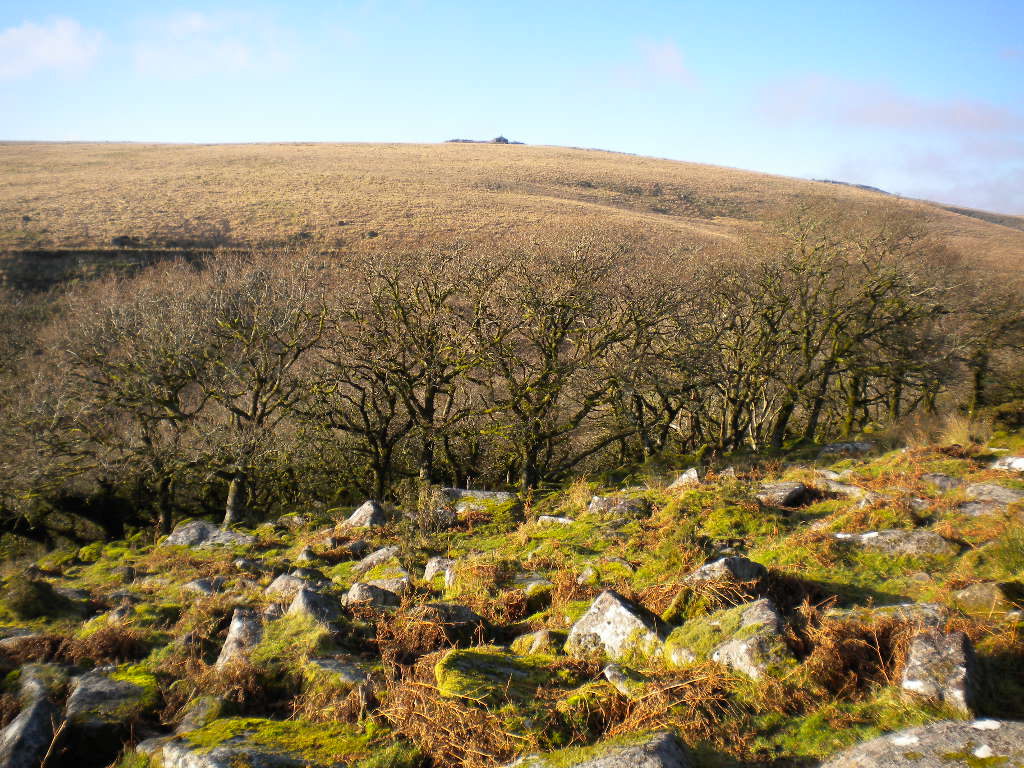

Wistman's Wood: the famous one
High on the West Dart above Two Bridges sits the wood everyone has seen a photograph of. Wistman's Wood is a National Nature Reserve on Duchy of Cornwall land, managed with Natural England, and it is strange: a stand of stunted pedunculate oaks growing straight out of a slope of granite boulders, every trunk and stone upholstered in moss. The lichens here are the real treasure — one of them, the horsehair lichen, is found at only two sites in Britain. Look up the slope to the north-east and you can pick out the ruins of more than a hundred prehistoric huts; people have been living beside this wood for a very long time.
The walk in starts from the small car park opposite the Two Bridges Hotel and runs about four kilometres there and back, turning rough, muddy and wet in its second half — proper boots, not trainers. One thing matters more than any other: the wood is now viewed from the path, not entered. The moss and lichen communities are too fragile to take footfall, so the days of scrambling over the boulders for a photograph are over. The view from outside is the better one anyway — you take in the whole gnarled shape of the thing against the valley.
The happier news is that Wistman's is growing. In 2023 the Duchy announced a plan to double the size of the wood, and in March 2025 the first 450 saplings went in — grown by the Dartington-based charity Moor Trees from locally collected acorns and rowan seed, with the Woodland Trust funding the fencing. The new trees are planted as a mirror image of the old wood across the valley. None of us will see them gnarled; our grandchildren might.
The quiet siblings: Black-a-Tor Copse and Piles Copse
Wistman's is one of just three high-altitude oakwoods on Dartmoor, and its two siblings see a fraction of the visitors. Black-a-Tor Copse, a National Nature Reserve strung for nearly a mile along the West Okement river below Black Tor, sits at around 1,300 feet and is, for our money, the most atmospheric of the three — the same twisted oaks and moss-deep boulders as Wistman's, with a real chance of having them entirely to yourself. The approach from Meldon Reservoir, near Okehampton, is a fine walk in its own right. The third of the trio, Piles Copse, stands in the Erme valley about five kilometres north of Ivybridge, on private farmland within a Site of Special Scientific Interest — the moorland paths of the valley give you good views of its oaks, though the wood itself is not open-access land.
Lydford Gorge: rainforest with a handrail
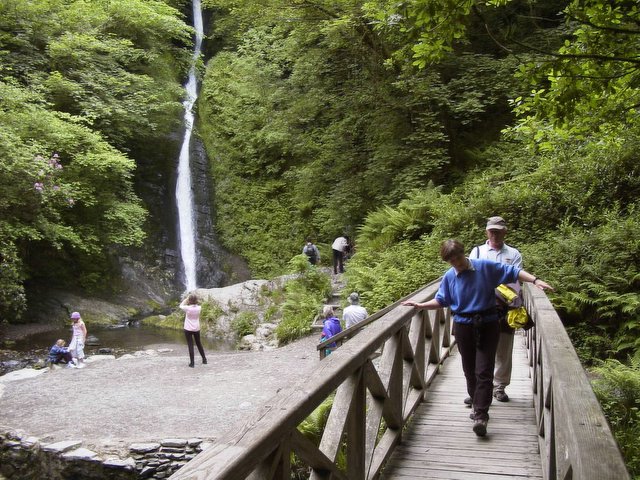
If the open moor feels like a big ask, Lydford Gorge is the place to meet this habitat with a tea-room at either end. The National Trust looks after the deepest river gorge in the South West here, where the River Lyd has carved itself a mossy, fern-lined slot through the rock. The Devil's Cauldron trail drops you onto a platform suspended above a churning pothole; the longer waterfall trail — about a mile and three quarters — leads to the White Lady, a thirty-metre ribbon of water falling through the trees. In autumn the whole gorge turns copper and gold over green.
Worth knowing: from 2 November 2026 only the waterfall trail and the railway path stay open for the winter, with the full circuit closed for maintenance until spring. If you want the Devil's Cauldron this year, go before then. Dogs are welcome on short leads, and parking at both entrances is free.

Fingle Woods and the Teign Gorge
On the north-east edge of the moor, the Teign has cut a gorge of its own, and its slopes carry one of the most ambitious woodland restoration projects in the country. Fingle Woods — 655 acres of it — is jointly owned by the Woodland Trust and the National Trust, the first venture of its kind between the two charities. A century's worth of planted conifers is being gradually cleared so the ancient oakwood underneath can breathe again, and the early results are lovely: 28 miles of paths, thirty-six species of breeding bird, a dozen kinds of bat, and otters working the river below.
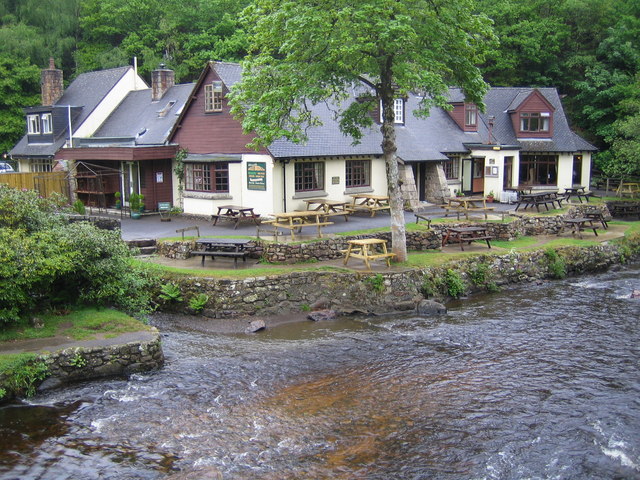
Start at Fingle Bridge, where the old granite bridge crosses the Teign and the Fingle Bridge Inn sits right on the bank for afterwards. If a pub with history in its walls is your preferred way to end a walk, our guide to Devon's medieval church house pubs rounds up several more within easy reach of the moor.

The southern gorges: the Dart and the Plym
The south moor's rivers run through rainforest too. On the Dart between New Bridge and Buckfast, Hembury and Holne Woods are ancient western oakwood at its unmanicured best — a big, barely signposted tangle of paths where you choose your own way, with dippers and kingfishers on the water, pied flycatchers in the oaks, and fallow deer if you're quiet. Above the trees at Hembury sits a double history lesson: an Iron Age hillfort with a Norman motte planted inside it, and old adits in the valley from the days when copper and silver-lead were mined here.
Over on the Plym, park at Shaugh Bridge, where the Meavy meets the Plym beneath the Dewerstone — a granite crag rising 160 metres above the river, beloved of climbers and, in Dartmoor folklore, the haunt of the Dewer himself, the Devil, said to drive his hunt over its edge on wild nights. The oakwoods below are as mossy as anywhere in this article, threaded with the remains of nineteenth-century quarries and brickworks, and there are two waymarked walks from the car park, a gentle mile-long circuit and a longer moorland loop.
Yarner Wood and the Bovey Valley
Near Bovey Tracey, the East Dartmoor Woods and Heaths National Nature Reserve gathers Yarner Wood, Trendlebere Down and the Bovey Valley woodlands into one of the richest wildlife sites in the county. Oak dominates, with alder and willow in the wet ground, and the reserve is famous for its western woodland birds — pied flycatchers and redstarts breed here in spring — along with dormice and the scarce high brown fritillary butterfly. There's a bird hide in Yarner Wood, the Templer Way passes through, and the car park sits just off the Bovey Tracey to Becky Falls road. On a still October morning, with fungi pushing up through the leaf litter, it is as good as Devon woodland gets.
A rainforest being planted: Bowden Pillars
The most hopeful chapter of this story is being written just outside Totnes. At Bowden Pillars, a 75-acre site on the shoulder of the Dart valley, Devon Wildlife Trust has taken a 105-year lease to create a brand-new temperate rainforest — the first site in the South West supported by the Wildlife Trusts' Atlantic rainforest recovery programme. Two-thirds of the land is being planted with sessile oak, birch, rowan, holly, alder, willow and hazel, and volunteers put thousands of the first trees in the ground over the winter of 2025. A rainforest takes longer than a lifetime to make, which is rather the point: this one is a gift to people who haven't been born yet.
Going gently
A last word on manners, because these are among the most fragile places Devon has. Stay on the paths at Wistman's and let the wood be looked at rather than climbed on. Leave the moss where it grows. Watch your footing on wet granite and roots. And don't wait for a fine forecast: drizzle is when a rainforest performs, the greens turning almost luminous and the crowds staying home. If you come off the moor soaked through and want to warm up the Devon way, our guide to Devon's wild sauna boom has you covered. Take a flask, take your time, and go and see the rainforest we nearly forgot we had.