Devon is a county that rivers keep interrupting. The Dart, the Teign, the Exe, the Avon, the Torridge — each one cuts deep inland, and each one turns what looks like a short walk on the map into a long drive around by the nearest bridge. The locals' answer, for seven centuries and counting, has been the little ferry: a boat, sometimes barely bigger than a dinghy, that takes you straight across for the price of a coffee and hands you the best view in Devon on the way. Some of these crossings are older than the roads that eventually replaced them. A few come with genuine eccentricities — a brass bell you ring to summon the boatman, a livery of painted gunports, a tractor that drives into the sea. Most of the seasonal ones run until the end of September or October, which makes late August exactly the right time to go and ride them.
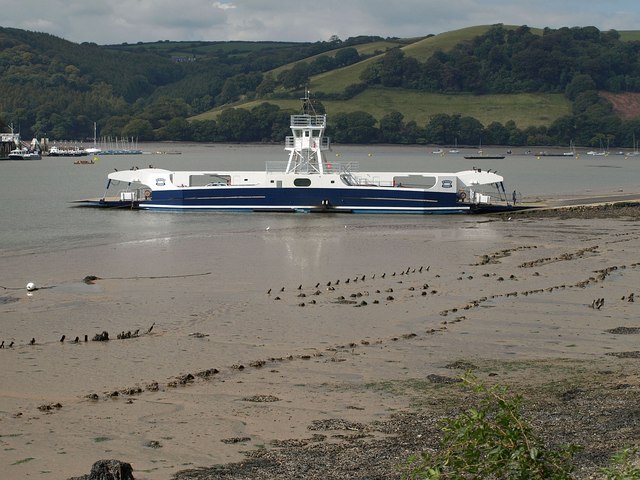

The Dart: a floating bridge, a tug, and a bell
The Dart has no road bridge below Totnes, which is why Dartmouth and Kingswear — two towns close enough to shout across — still depend entirely on boats. The Higher Ferry is the strangest and, in its way, the grandest: a ferry has crossed here since at least 1365, and since 1829 the crossing has been made by a "floating bridge" that hauls itself over on cables stretched bank to bank. The first one was designed by the engineer James Meadows Rendel; for a spell in the 1830s it was wound across by horses walking a treadmill. The current bridge, in service since 2009, carries cars, and the sensation on board is unlike any other ferry in Devon — no bow, no wake, just a steady sideways glide.
Downstream, the Lower Ferry has been shuttling between Dartmouth and Kingswear since the 1700s and works on an equally odd principle: a flat float, pushed and steered by a tug lashed alongside. It runs year-round, every day except Christmas Day, and the short crossing gives you Britannia Royal Naval College on one side and Dartmouth Castle guarding the river mouth on the other. Fair warning: the queues lengthen when the town fills up for the Port of Dartmouth Royal Regatta at the end of August — we've written a full guide to Devon's regatta season if you're tempted to combine the two.
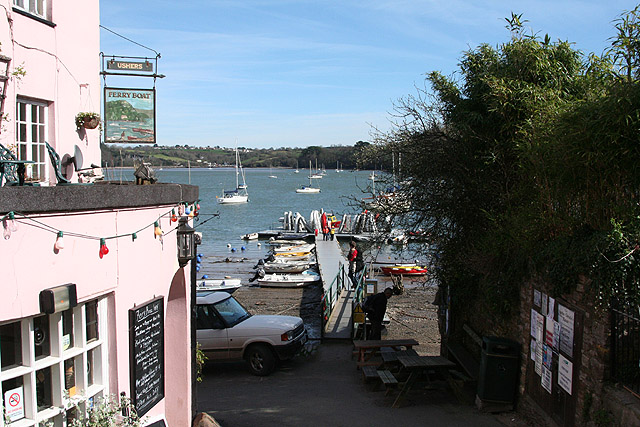
The Dart saves its best trick for Dittisham. There's no timetable for the little ferry across to Greenway Quay; instead you walk down to the quay by the Ferry Boat Inn and ring the brass bell, and the boat comes over for you. The crossing takes about five minutes and lands you at the foot of Greenway, Agatha Christie's holiday home, now kept by the National Trust. Ringing a bell to summon a ferryman feels like something Devon should have lost a century ago. It hasn't, and long may that continue.

The Teign: England's oldest ferry?
The black-and-white boat that crosses between Teignmouth's river beach and Shaldon may be the most storied of the lot. Records trace a ferry on this crossing back to 1296, and its operators make a fair claim to its being the oldest passenger ferry service in England — there was very likely a boat here in Saxon times. The livery has its own history: after the Napoleonic Wars the rowing ferries were painted with mock gunports so they resembled little men-of-war, and when motor boats took over in 1907 the paint job came with them. It survives today, right down to ferry No. 4, built in 1946 and still owned by the district council, which has held the crossing rights since the 1950s. The boat runs up onto the sand at each end — you step off the beach, cross the Teign, and step onto another beach, which is about as pleasing as public transport gets.
The Exe: wide water, a lock with no road, and a pub to earn
The Exe estuary is Devon's widest, and its ferries do real work. From Exmouth you can cross the mouth of the estuary to Starcross, seven days a week in season, weather permitting — bikes and dogs travel too, which makes it the essential link for anyone riding the Exe Estuary Trail in a loop rather than an out-and-back. On a clear day the crossing is a slow pan across sandbanks, moorings and wading birds, with Dawlish Warren's dunes closing the view to seaward.
Upstream at Topsham, the city council still runs a small ferry from Ferry Road across to Topsham Lock on the western bank — a landing with no road to it at all, just the estuary trail running north and south. And from Trout's Boatyard nearby, a seasonal wooden ferry makes the run downriver to the Turf, the pub that stands where the Exeter Ship Canal meets the estuary. The Turf is famously not fully reachable by car — the nearest car park is the better part of a mile away — so its regulars arrive on foot, by bike or by water, and the pint tastes better for the effort. Devon has long specialised in pubs that ask something of you first; the medieval church house inns we wrote about earlier this summer made you cross a churchyard, and the Turf makes you cross a river. Sailing times for the Turf boat shift with the season, so check before you build an afternoon around it.
Salcombe: ferry steps and a tractor in the sea
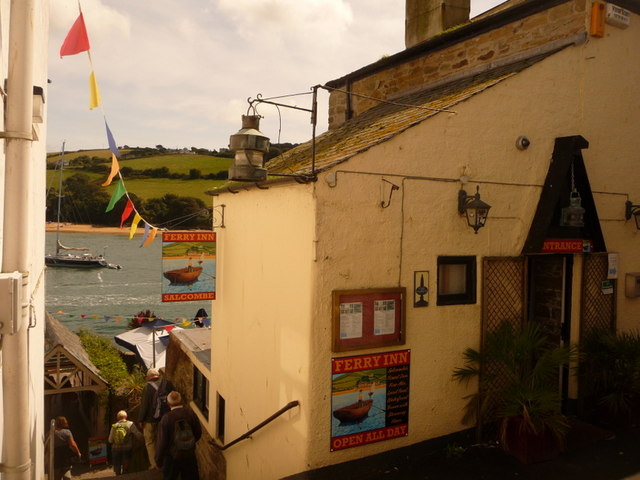
Salcombe's ferry to East Portlemouth is the shortest commute in the South Hams and one of the loveliest anywhere: a few minutes from the steps by the Ferry Inn across to the sandy coves on the eastern shore, where the crowds thin and the water is a shade of green that gets Devon accused of exaggeration. It runs every day, all year — in winter it simply moves its Salcombe end to the Whitestrand pontoon — and it turns the quiet side of the estuary into somewhere you can actually get to. East Portlemouth rewards the trip; we covered its clifftop sauna in our guide to Devon's wild sauna boom, and the beaches below it need no introduction at all.

The other Salcombe ferry solves a different problem: South Sands beach has no deep-water landing, so the boat from town anchors off and a sea tractor — a platform on huge wheels that drives straight into the surf — wades out to meet it. Passengers ride the tractor over the water to the sand, to the delight of every child on board and most of the adults. The service has run for more than seventy years; the present boat dates from 1984, the Tucker family have operated it since 1986, and the current tractor is the third of its line, launched in 2014 when its predecessor retired after thirty years' paddling. It runs half-hourly from spring to the end of October.
The Avon and the Torridge: small boats, big shortcuts
The prettiest shortcut in the South Hams might be the tiny ferry over the River Avon between Bantham and Cockleridge Ham, on the Bigbury side. It runs from April to the end of September, in morning and mid-afternoon shifts, and spares coast path walkers a detour of several miles around the estuary. One minute you're on Bantham's dunes; the next you're walking off the sand towards Bigbury-on-Sea with Burgh Island sitting offshore like a stage set.
North Devon's crossing is the one with the strongest community story. The ferry between Appledore and Instow — two shipbuilding-and-sandbar villages that face each other across the Torridge — is run entirely by volunteers, not for profit, with two little boats licensed for twelve passengers apiece. The Torridge empties dramatically at low water, so the ferry works to the moon rather than the clock, running roughly two hours either side of high tide, daily from April to October. Check the tide tables, buy your ticket by card on board, and you get the crossing Appledore's shipwrights and pilots made for centuries, with Instow's beach and dunes waiting on the far side.
Catch them while they're running
A few of these boats work all year — the Dartmouth ferries, Salcombe to East Portlemouth — but most are seasonal creatures that tie up when the clocks change, and the tide-run services can drop sailings at short notice when the weather turns. The rule for all of them: check times on the day, carry a means of paying that isn't a crumpled fiver, and don't plan the sort of schedule that can't absorb a twenty-minute wait on a quay in the sunshine. That wait, honestly, is half the point. There are worse places to stand than a ferry slip in Devon in late summer, watching a small boat come over the water for you.